Tag Archives: awareness

Presidential Proclamation – NDEAM 2013

National Disability Employment Awareness Month, 2013
By the President Of The United States Of America
A Proclamation

Our Nation has always drawn its strength from the differences of our people, from a vast range of thought, experience, and ability.  Every day, Americans with disabilities enrich our communities and businesses.  They are leaders, entrepreneurs, and innovators, each with unique talents to contribute and points of view to express.  During National Disability Employment Awareness Month, we nurture our culture of diversity and renew our commitment to building an American workforce that offers inclusion and opportunity for all.

Since the passage of the Americans with Disabilities Act, we have made great progress in removing barriers for hardworking Americans.  Yet today, only 20 percent of Americans with disabilities, including veterans who became disabled while serving our country, participate in our labor force.  We need their talent, dedication, and creativity, which is why my Administration proudly supports increased employment opportunities for people with disabilities.  To that end, I remain dedicated to implementing Executive Order 13548, which called on Federal agencies to increase recruitment, hiring, and retention of people with disabilities.  As a result of our efforts, the Federal Government is hiring people with disabilities at a higher rate than at any point in over three decades.  Most recently, we updated the rules to make sure Federal contractors and subcontractors are doing more to recruit, hire, and promote qualified individuals with disabilities, including disabled veterans.  And thanks to the Affordable Care Act, States are taking advantage of new options to support and expand home and community-based services.

In the years to come, I will remain committed to ensuring the Federal Government leads by example.  This year, as we mark the 40th anniversary of the Rehabilitation Act, I will continue to marshal the full resources of my Administration toward effective and comprehensive implementation.

If we swing wide the doors of opportunity for our family, friends, and neighbors with disabilities, all of us will enjoy the benefits of their professional contributions.  This month, let us uphold the ideals of equal access, equal opportunity, and a level playing field for all Americans.

NOW, THEREFORE, I, BARACK OBAMA, President of the United States of America, by virtue of the authority vested in me by the Constitution and the laws of the United States, do hereby proclaim October 2013 as National Disability Employment Awareness Month.  I urge all Americans to embrace the talents and skills that individuals with disabilities bring to our workplaces and communities and to promote the right to equal employment opportunity for all people.

IN WITNESS WHEREOF, I have hereunto set my hand this thirtieth day of September, in the year of our Lord two thousand thirteen, and of the Independence of the United States of America the two hundred and thirty-eighth.

BARACK OBAMA
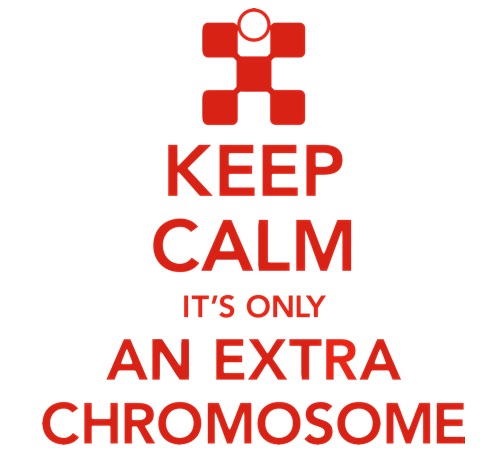
Keep Calm It’s Only An Extra Chromosome

keep calm its only extra chromosome - Down Syndrome Awareness Month

Despite the incredible number of medical advances which have enriched and extended the lives of people with Down syndrome, Trisomy 21 continues to be extremely misunderstood. Many people look at Down syndrome through the lens of outdated stereotypes and misconceptions.

Down Syndrome Awareness Month, celebrated each October, is one way to change that. The goal of Down Syndrome Awareness Month is, of course, to spread awareness, to educate about Down syndrome, and to celebrate people who have Down syndrome, and their abilities and accomplishments.

Facts about Down syndrome:

  • What is Down syndrome?
    Trisomy 21, or Down syndrome, is a genetic disorder which is caused by a full or partial third copy of the 21st chromosome. There are three types of Down syndrome. Trisomy 21, or nondisjunction, is the most common kind, seen in 95% of Down syndrome cases. The extra chromosome is present in every cell in the body. Translocation Down syndrome occurs in about 4% of Down syndrome cases and is caused by a partial copy of the 21st chromosome breaking off and attaching to another chromosome (usually the 14th chromosome). Finally, Mosaic Down syndrome is the rarest case, seen in about 1% of Down syndrome cases. Mosaic Down syndrome happens when the nondisjunction of an extra chromosome is present in some, but not all, of the body’s cells. Some cells will have 47 chromosomes, while the rest will have the typical 46 chromosomes.


  • Is Down syndrome rare?
    No, Down syndrome is not rare. It is the most commonly occurring genetic disorder or birth defect. One out of every 691 babies born in the United States will have Down syndrome, and there are over 400,000 people who have Down syndrome living in the United States. Down syndrome occurs in all races, and while women are at a greater risk of conceiving a child with Down syndrome as they get older, the majority of babies with Down syndrome are born to younger mothers.


  • What are the effects of having Down syndrome?
    People with Down syndrome usually have hypotonia, or low muscle tone, and developmental delays. Early intervention programs and therapies are able to help children with Down syndrome reach the same milestones as typical children, albeit at a slightly longer pace. The rate at which the person with Down syndrome reaches these milestones, as well as the developmental delays he or she has, will be highly individual. There usually are cognitive delays as well, ranging from mild to moderate. It is important to remember, though, that each person with Down syndrome is different, just like typical people. People with Down syndrome are also at increased risk for various medical conditions, such as heart defects, hearing problems, thyroid conditions, childhood leukemia, and Alzheimer’s. However, medical advances have made most of these issues highly treatable, to the point where people with Down syndrome have life expectancies similar to those of people with typical chromosomes.


  • What are the physical characteristics of Down syndrome?
    There are common markers for Down syndrome, which include almond-shaped eyes, a single crease in the palm, flat facial features, small ears, and extra space between the big toe and second toe. However, each person with Down syndrome is an individual, so some people may exhibit many of these characteristics, while others will not have any.


  • Can people with Down syndrome lead normal, fulfilling lives?
    People with Down syndrome often do work and make contributions to society. They also get married, as well as have friendships and other meaningful relationships. Unfortunately, most men with Down syndrome cannot have children, or have a lower fertility rate than typical men. About 50% of women with Down syndrome are able to have children. Thirty-five to fifty percent of children born to a mother with Down syndrome will also have Down syndrome, or other developmental delays. Most importantly, people with Down syndrome do lead happy, fulfilling lives. Studies have consistently shown that people with Down syndrome overwhelmingly report being happy with themselves, their lives, and how they look.


  • Are people with Down syndrome always happy?
    No. People often refer to people with Down syndrome as always happy, or as constantly full of love and joy, but this does a disservice to people with Down syndrome. They experience the full range of emotions, just like everyone else. Reducing them to one emotion or one feeling reduces them to less of a person. They feel happiness, along with sadness, anger, frustration, and countless other feelings, and they deserve to have those feelings acknowledged.

National Disability Employment Awareness Month Facts & Figures

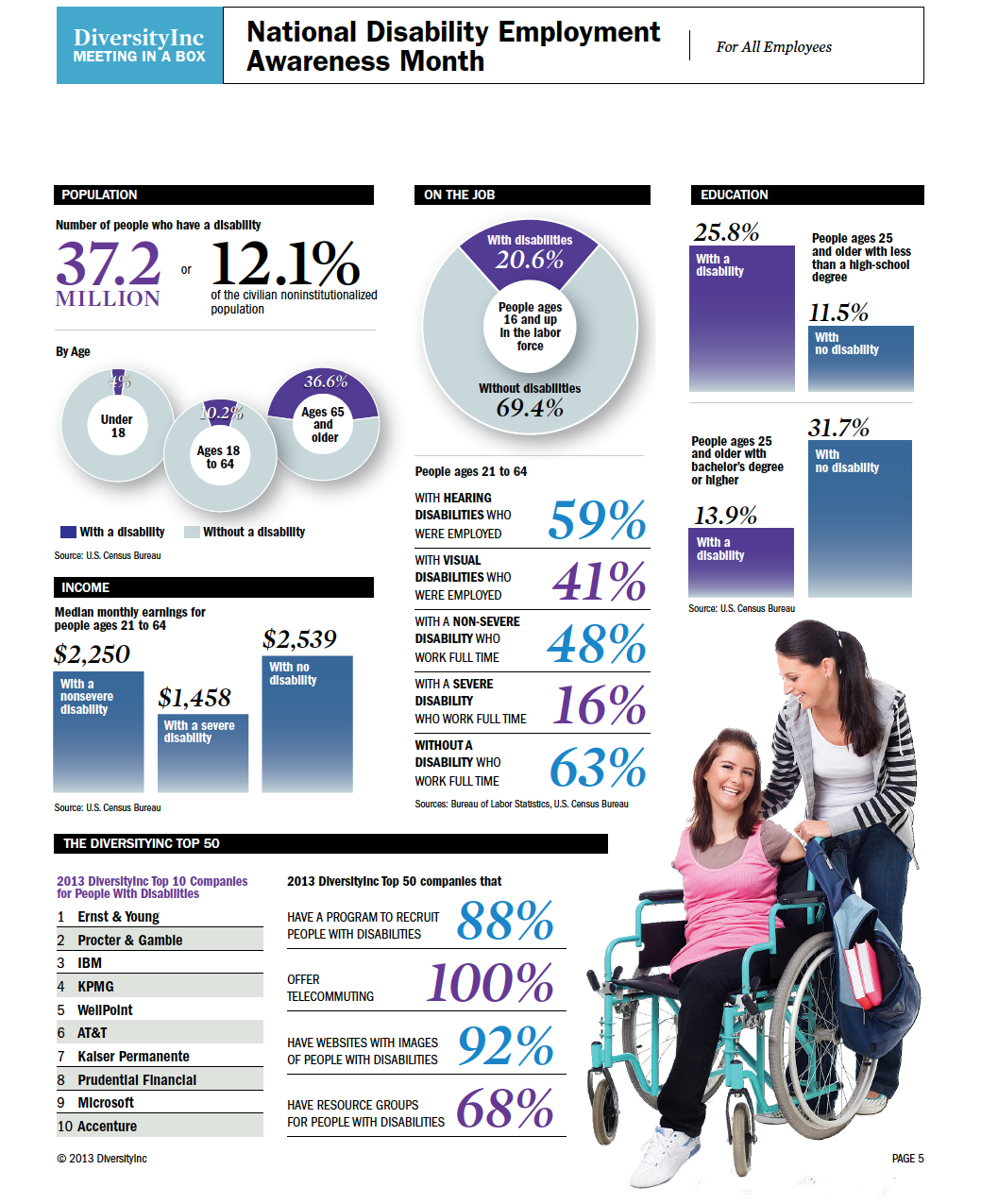
National Disability Employment Awareness Month 2013 facts & figuresHeld each October, Disability Employment Awareness Month is a national campaign that raises awareness about disability employment issues. The opportunity to earn a living and be self-supporting is a broadly held goal by Americans. Work is a foundation of stability for individuals and can give one’s life meaning and purpose.  Unfortunately, the rate and level of employment for people with disabilities is staggeringly low. Labor force participation is 22% for people with disabilities as compared to 69% for people without disabilities.

National Disability Employment Awareness Month 2013

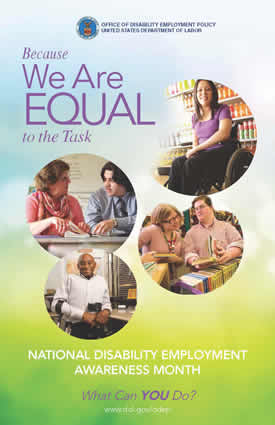
Because We Are EQUAL to the Task

2013 NDEAM Poster

Held each October, National Disability Employment Awareness Month (NDEAM) is a national campaign that raises awareness about disability employment issues and celebrates the many and varied contributions of America’s workers with disabilities. The theme for 2013 is “Because We Are EQUAL to the Task.”

NDEAM’s roots go back to 1945, when Congress enacted a law declaring the first week in October each year “National Employ the Physically Handicapped Week.” In 1962, the word “physically” was removed to acknowledge the employment needs and contributions of individuals with all types of disabilities. In 1988, Congress expanded the week to a month and changed the name to “National Disability Employment Awareness Month.” Upon its establishment in 2001, ODEP assumed responsibility for NDEAM and has worked to expand its reach and scope ever since.

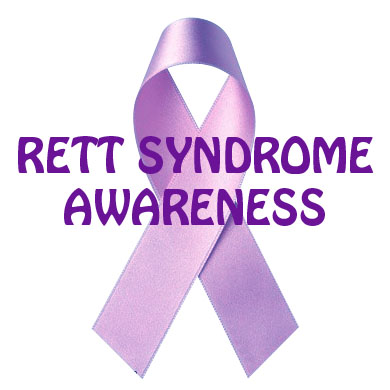
October is Rett Syndrome Awareness Month

Rett Syndrome Aweareness month

What is Rett Syndrome?
Rett syndrome is a postnatal neurological disorder seen almost always in girls, but can be rarely seen in boys. It is not a degenerative disorder.

Rett syndrome is caused by mutations on the X chromosome on a gene called MECP2. There are more than 200 different mutations found on the MECP2 gene. Most of these mutations are found in eight different “hot spots.”

Rett syndrome strikes all racial and ethnic groups, and occurs worldwide in 1 of every 10,000 to 23,000 female births.

Rett syndrome causes problems in brain function that are responsible for cognitive, sensory, emotional, motor and autonomic function. These can include learning, speech, sensory sensations, mood, movement, breathing, cardiac function, and even chewing, swallowing, and digestion.

Rett syndrome symptoms appear after an early period of apparently normal or near normal development until six to eighteen months of life, when there is a slowing down or stagnation of skills. A period of regression then follows when she loses communication skills and purposeful use of her hands. Soon, stereotyped hand movements such as handwashing, gait disturbances, and slowing of the normal rate of head growth become apparent. Other problems may include seizures and disorganized breathing patterns while she is awake. In the early years, there may be a period of isolation or withdrawal when she is irritable and cries inconsolably. Over time, motor problems may increase, but in general, irritability lessens and eye contact and communication improve.

Rett syndrome can present with a wide range of disability ranging from mild to severe. The course and severity of Rett syndrome is determined by the location, type and severity of her mutation and X-inactivation. Therefore, two girls of the same age with the same mutation can appear quite different.


Testing and Diagnosis
Rett syndrome is most often misdiagnosed as autism, cerebral palsy, or non-specific developmental delay. In the past, making the correct diagnosis called not only for a long list of diagnostic tests and procedures to rule out other disorders, but it also took from months to years waiting to confirm the diagnosis as new symptoms appeared over time. Today, we have a simple blood test to confirm the diagnosis. However, since we know that the MECP2 mutation is also seen in other disorders, the presence of the MECP2 mutation in itself is not enough for the diagnosis of Rett syndrome. Diagnosis requires either the presence of the mutation (a molecular diagnosis) or fulfillment of the diagnostic criteria (a clinical diagnosis, based on signs and symptoms that you can observe) or both. Below is a list of labs to share with your ordering physician that can do the MECP2 sequencing + deletion analysis, and the list of diagnostic criteria.