Tag Archives: awareness

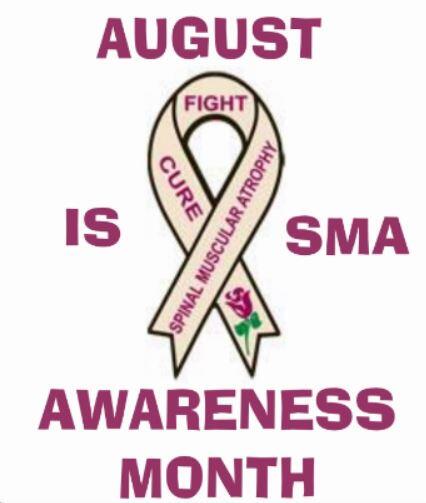
August is National Spinal Muscular Atrophy Awareness Month

Since 1996, Spinal Muscular Atrophy Awareness Month has worked to increase awareness of this condition, hoping that a boost in the public’s knowledge about SMA will improve resources for research and provide better care for patients.

What can YOU do to help?
As with any cause, getting the message out to the public is the best way to help. Here are a few ways through which you can let your family, friends and colleagues know about SMA Awareness Month.

Host an Event
Whether it’s a picnic at the park or a fundraiser at your library, an event can help promote SMA Awareness Month to a large number of people. Look into posting your event on your community’s calendar, in order to attract an even larger turnout.

Display Promotional Materials
To help enhance awareness events, you can choose to make or purchase promotional materials containing information about SMA, organizations working to find a cure, and ways to donate. Some families and groups have come up with creative ways to display informational materials, like posting ribbons with SMA facts throughout their neighborhood!

Spread the Word
If you are asked questions regarding SMA or your efforts during awareness month (or anytime of the year!), take the opportunity to educate others about the disease. Share all the knowledge you can and instruct those around you on how they, too, can help.

Donate
While this may not be a possibility for us all, monetary contributions can directly go towards funding life-saving research and scientific efforts. Whenever possible, make a donation to support the battle against SMA.

The efforts of those involved in Spinal Muscular Atrophy Awareness Month can help advance the search for a treatment or cure for those living with the disease. However you choose to get involved, we urge you to support this cause.
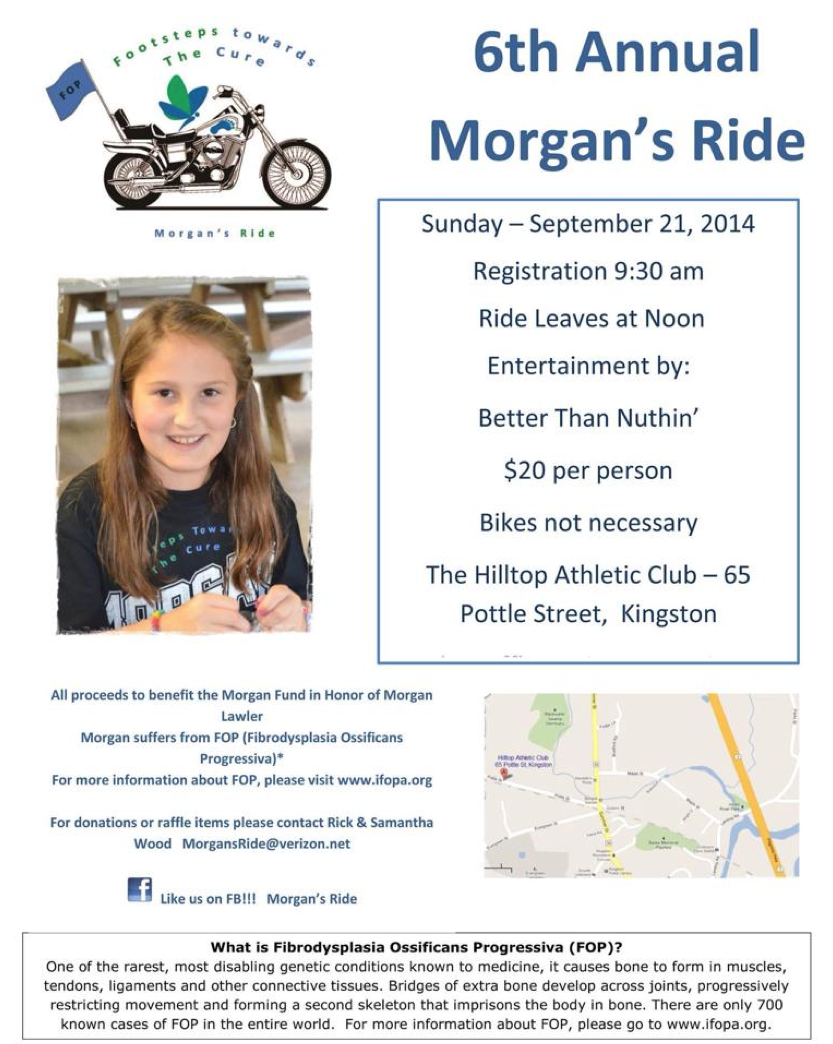

6th Annual Morgan’s Ride!

6th Annual Morgan's Ride

6th Annual
Morgan’s Ride

———-

What?
Motorcycle Ride – Live Entertainment *Better than Nuthin’* – and More
*Bike not required to participate, EVERYONE IS WELCOME!*

When?
Sunday, September 21, 2014
Registration at 9:30am — Ride leaves at noon

Where?
The Hilltop Athletic Club
65 Pottle Street
Kingston, MA

Why?
All Proceeds to benefit the Morgan Fund in Honor of Morgan Lawler.
Morgan Suffers from FOP (Fibrodysplasia Ossificans Progressiva)

How Much?
$20 Donation per person
For Donations or raffle items please contact Rick & Samantha Wood
MorgansRide@verizon.net

Website
Facebook Page

Fibrodysplasia Ossificans Progressiva

What is Fibrodysplasia Ossificans Progressiva (FOP)?
One of the rarest, most disabling genetic conditions known to medicine, it causes bone to form in muscles, tendons, ligaments and other connective tissues. Bridges of extra bone develop across joints, progressively restricting movement and forming a second skeleton that imprisons the body in bone. There are no other known examples in medicine of one normal organ system turning into another.

An example of the typical progression of FOP:
Spontaneous flare-ups of the disease arise in defined temporal and spatial patterns, resulting in ribbons and sheets of bone that fuse the joints of the axial and appendicular skeleton, entombing a patient in a skeleton of heterotopic bone. These photos show an individual with FOP through his lifetime.

How would understanding the cause of bone formation in FOP help others?
The information obtained from studying this disease will have far reaching implications for the treatment of common disorders such as fractures, osteoporosis, hip replacement surgery, and other forms of heterotopic ossification that occur in trauma and burn victims.

Demographics of FOP:

  • Genetic disease affecting 1 in 2 million people
  • No ethnic, racial, or gender patterns
  • 800 confirmed cases across the globe
  • 285 known cases in the United States

Clinical Characteristics of FOP:

  • Characteristic malformations of the great toe
  • Flare-ups occur spontaneously or following bodily trauma such as: childhood immunizations, falls while playing, viral illnesses
  • Misdiagnosed in a majority of cases as cancer
  • Surgery makes the condition worse
  • There are no effective treatments

Finding a Cure and Treatment for FOP:

  • Researchers at the University of Pennsylvania School of Medicine, the only laboratory in the US dedicated to FOP research, announced the Discovery of the FOP Gene in Nature Genetics in April 2006.
  • 10,000 sq. ft. of shared research space in the Department of Orthopaedic Surgery
  • 3 principal investigators with 15 post-doctoral fellows, students, scientists, and staff
  • Funds spent on research – Approx. $1.5 million/year
  • 75% from FOP family fundraising and donations
  • 25% from institutional support (NIH/NIAMS, Orthopaedic Research and Education Foundation)

Today is the Freedom Fest at Fort Kent, Maine

August 9th 2014 Freedom Fest

Freedom Fest 2014 is an outdoor concert on August 09, 2014 in Fort Kent, Maine to raise funds for a
Veterans Museum & Community Center in Northern Maine.
A joint project of Martin-Klein American Legion Post 133 and the Fort Kent Historical Society

“So that the future can understand what the past has given in the name of Freedom”


Their Vision
To build a Veterans Museum & community center in Northern Maine to showcase and appreciate the sacrifices provided on our behalf so that our children and future generations will understand the true cost of freedom. The Center shall be a living, breathing kiosk of history providing a dynamic educational opportunity for all those in the community!

Fort Kent Municipal Airport

Tickets: FreedomFest2014.bpt.me
ADULT: $40/$35 advance purchase
Under 16: $25   Under 12: FREE 
or visit Albert’s Jewelry or Gas-n-Go Foods in Fort Kent
Bring your own chair or blankets
NO Backpacks
NO Coolers

Contact Information
Duane Belanger – Martin-Klein American Legion
Email: commander@americanlegionpost133.org
Chad Pelletier – President of Fort Kent Historical Society
Email: fkhistory1@yahoo.com

Featuring
Thomas Nicholas Band
Madison Rising
Mallett Brothers Band
Spirit of Cash
Harold Ford
Laura Lucy & the Cash Band
Gunther Brown
Forget, Forget
Randolph S Michaud
Tennessee Haze
Uprooted
Kindered
Along with the cast of Freedom Fighters TV!
Featuring on opening Bike Run from Plourde Harley Davidson , Caribou to Fort Kent lead by the Patriot Guard Riders & First Lady Ann LePage honoring the fallen and respectfully welcomed in Fort Kent by the Saluting Marine SSG Tim Chambers!    Honored to welcome quad-amputee and American Hero SSG Travis MIlls as well!

Featuring a parachute jump by the First Lady of Maine & Travis Mills courtesy of Wreaths Across America!!

Vendors – Partners
VMI New England ● Fort Kent Lions ● Vets Rock ● Young Marines ● Toys For Tots ● Post 133 LadiesAuxiliary ● Fort Kent Knights of Columbus ● Market Street Coop ● Armed Forces Motorsports Foundation ● Maine Veterans Homes ● National Veterans Family Center ● US VA Togus ● Maine Military  & Community Network  ● Gas-N-Go Foods ● Albert’s Jewelry ● Maine Veterans Services ● VetCenter ● Maine National Guard
● VFW Department of Maine ● American Legion Department of Maine ● AMVETS  Department of Maine ● Fort Kent VFW ● Gary I Gordon Division Sea Cadets  ● KTC’s Brainfreeze  ● Mad Town Grillers ● Carter Dogs  ● Wreaths Across America ● Jeni’s Jewelry  ● JSB Arts ● Maine State Council Knights of Columbus  ● the Lunchbox ● Sally Bateau  ● Maine Army Guard 185th Engineer Company ● Honor & Remember – Massachusetts Chapter● Greater Fort Kent Area Chamber of Commerce

FREEDOM-FEST 2014
Make a Donation — http://www.iamtheamericanflag.com/donate/

Agust is SMA Awareness Month

 Agust is SMA Awareness Month 2014

August is SMA Awareness month and families and friends around the country are joining together to help increase awareness—not only of SMA, but also of our hope for a treatment and cure.

What is Spinal Muscular Atrophy?
Spinal Muscular Atrophy (SMA) Types I, II, and III belong to a group of hereditary diseases that cause weakness and wasting of the voluntary muscles in the arms and legs of infants and children. The disorders are caused by an abnormal or missing gene known as the survival motor neuron gene 1 (SMN1), which is responsible for the production of a protein essential to motor neurons. Without this protein, lower motor neurons in the spinal cord degenerate and die. The type of SMA (I, II, or III) is determined by the age of onset and the severity of symptoms. Type I (also known as Werdnig-Hoffman disease, or infantile-onset SMA) is evident at birth or within the first few months. Symptoms include floppy limbs and trunk, feeble movements of the arms and legs, swallowing and feeding difficulties, and impaired breathing. Type II (the intermediate form) usually begins 6 and 18 months of age. Legs tend to be more impaired than arms. Children with Type II may able to sit and some may be able to stand or walk with help. Symptoms of Type III (also called Kugelberg-Welander disease) appear between 2 and 17 years of age and include difficulty running, climbing steps, or rising from a chair.  The lower extremities are most often affected.  Complications include scoliosis and chronic shortening of muscles or tendons around joints.

Is there any treatment?
There is no cure for SMA. Treatment consists of managing the symptoms and preventing complications.

What is the prognosis?
The prognosis is poor for babies with SMA Type I. Most die within the first two years. For children with SMA Type II, the prognosis for life expectancy or for independent standing or walking roughly correlates with how old they are when they first begin to experience symptoms – older children tend to have less severe symptoms  Life expectancy is reduced but some individuals live into adolescence or young adulthood.  Individuals with SMA type III may be prone to respiratory infections but with care may have a normal lifespan.

What research is being done?
Between 2003 and 2012, the NINDS piloted the Spinal Muscular Atrophy Project to expedite therapeutics development for this hereditary neurodegenerative disease. The Project was designed to accelerate the research process by identifying drugs that increase the level of SMN protein in cultured cells, so that they could be used as potential leads for further drug discovery and clinical testing. Read more about the history of this pioneering effort and how it led to collaboration with several pharmaceutical and biotechnology companies.